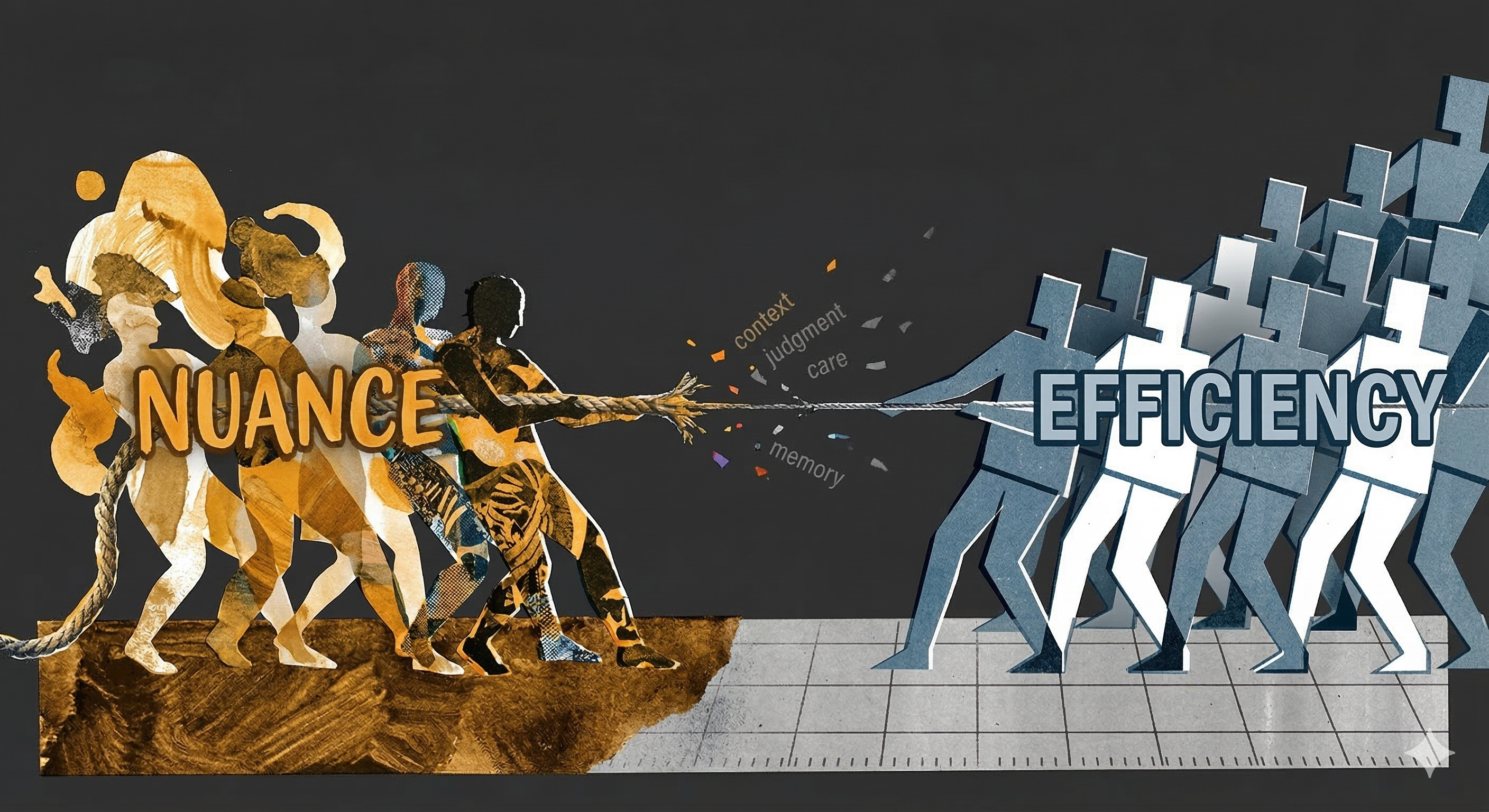
Something I have been thinking a lot about for the last few months are systems at scale. Pick up any system – education, healthcare, government, law, administration, large corporations, anything at scale. And almost invariably you find people complaining about it. This system is broken, that is broken.
And the problem is neither the people nor the system. It is the nature of scale itself. What we do to achieve it and what we compromise in doing so. That tension. That tradeoff that nobody really talks about honestly.
In fact what prompted me to write this was something that happened just a few hours ago:
I just came out of this Science on Tap lecture and met this researcher (PhD thesis on biofilms) the bad side of biofilms specifically. And I just asked her, casually, why this, why did you pick this. And she just told me straight. No origin story about being mesmerized by a microscope at age seven. She said there was a government policy push, funding was flowing that direction, papers were easier to get published in that space, so. That’s where she went.
And then I pushed a little more. Why the bad side specifically. Because biofilms are everywhere and fascinating in both directions. The bad side, yes, wounds, infections, diabetes complications. But also the good side. Kombucha. Cheese. Fermentation. Entire ecosystems of useful microbial cooperation that we barely understand. And she said the government incentive at the time was specifically toward biofilms, wounds and diabetes. So that’s the box the funding came in. And if you wanted the funding, you got in the box. The good side of biofilms, the kombucha, the cheese, all of it, that just sat there, equally interesting, equally worth understanding, but outside the box. So largely unstudied. Not because it doesn’t matter. Because nobody was paying for it.
And I don’t know why that hit me so hard but it did.
She could see the gap between what she was doing and why she was doing it. And she did it anyway. Not because she’s weak or dishonest but because what else do you do. The system made one path easy and every other path hard and she’s a human being trying to survive inside it.
That’s the whole thing which brings me to the concept of incentives and the dual nature of any system at scale.
Every system, every government, company, family, marketplace, religion, every one of them, runs two operating systems simultaneously. What it says it values. And what it actually rewards. And when those two things are the same, great, beautiful, the system works. But when they diverge, and they always diverge, the incentive structure wins.
Always. Not sometimes. Always. You can want the other thing all you like but the incentive structure is patient and it is structural and it will outlast your good intentions every single time.
And to incentivize, the system needs to measure success. And to measure success it needs to define metrics. And this is where the problem is solved as well as created.
Let’s talk about proxy. Not what you did at college for your friend, but a lot to understand from there as well.
There’s this paper, Proxyeconomics, and it basically formalizes everything I’ve been vaguely feeling for years into something rigorous and it’s kind of devastating to read.
But first, what even is a proxy. Because the definition itself is the whole story if you read it carefully.
A proxy is an indirect, measurable variable used to represent something that cannot be directly measured.
Read that again. Indirect. Measurable. Used to represent something else. The reason you reach for a proxy is precisely because the real thing resists measurement. Quality of life is too complex so you use GDP. Good science is too slow to evaluate so you use impact factor. Genuine health is too nuanced so you count steps. The proxy doesn’t get chosen because it’s accurate. It gets chosen because it’s trackable.
And this is exactly what a metric is.
A metric is just a proxy that has been given institutional authority.
That’s it. That’s the whole difference.
A proxy becomes a metric when the system decides to organize competition around it. When it starts determining who wins and who loses. When it gets put in a dashboard and reviewed in a quarterly meeting. The word changes. The problem doesn’t. They are the same thing at different stages. And the moment you make a trackable-but-indirect variable the basis of competition, you have set something in motion that you cannot easily stop.
Because here’s what the definition doesn’t tell you. The proxy doesn’t stay in its lane. It expands. It starts to feel like the thing itself. And eventually people forget there was ever a difference. The metric stops being a representation of the goal and becomes the goal. And that substitution happens so gradually that nobody notices the moment it occurs.
The core of the paper is this. Whenever society sets up competition around a goal, it has to use a proxy to measure performance. Because the real goal is too abstract, too complex, too slow to measure directly. So you pick something correlating with it.

And the moment you make that proxy the basis of competition, people stop chasing the goal and start chasing the number. Not because they’re bad people. Because the system selects for it. The ones who optimize hardest for the proxy survive. The ones who insist on the real goal fall behind. And slowly, generation by generation, practice by practice, the population inside the system tilts toward the proxy. It’s not corruption in the dramatic sense. It’s just evolution. The system naturally selects for exactly the behavior that breaks it.
And here’s the part that really stayed with me. It doesn’t collapse. It doesn’t spiral into total failure. It finds a stable level of rot and just. Sits there. The paper calls it an equilibrium. I keep thinking about that word. Equilibrium.
Like it’s fine, like the system has simply found its resting state, which happens to be a state where everyone is playing a game they know is broken and nobody can stop because the cost of stopping falls entirely on the individual while the benefit gets distributed across everyone. So no one stops. The researcher keeps studying biofilms. The scientist keeps salami slicing papers. The executive keeps optimizing for quarterly numbers.
Not because they don’t know. Because they do know. And it doesn’t matter.
The paper even has a name for it. Lock-in. You’re locked in not by ignorance but by structure. Everyone sees it. Nobody moves.
And scale. God, scale is where it all starts.
But wait, is scale actually the problem? I keep asking myself this.
Because I’ve now been part of about three startups. And across all three I watched the same pattern repeat itself so precisely that it started to feel almost choreographed.
Each time, in the beginning, the goal is alive in the room. You can feel it. Everyone knows what they’re building and why. Decisions get made by feel, by judgment, by the actual thing you’re trying to create. And then you grow. And something almost imperceptible starts to happen. You hire, you coordinate, you write things down that used to just be understood. And slowly the living goal gets compressed into something that fits in a slide, a metric, a dashboard. And once it’s in the dashboard it starts to calcify. And people start optimizing for the dashboard. Not through any bad intention. Just because the dashboard is what’s visible and the goal is now abstract.
I watched this happen three times. Same arc. Slightly different details. And that repetition is what made me realize this isn’t about bad founders or bad culture or bad execution. It’s structural. It happens because of what you have to do to coordinate humans at scale.
So is scale the problem. I don’t think so. Scale itself is just many people doing something together. What breaks is what you have to do to achieve it. And that’s the thing worth staring at directly.
One person operation, you’re fine, the goal is right there in front of you, you can feel it, you can course correct in real time. But you grow. Five people, fifteen, fifty, a hundred, and suddenly you have a coordination problem and the solution to every coordination problem is the same.
Standardize, simplify, compress the vision into something digestible, create rules people can follow without needing to understand the whole thing. And to achieve that coordination, the system optimizes for efficiency. And in doing so there is a death of nuance. It has to happen.
Efficiency and nuance are in direct tension and efficiency always wins at scale because nuance doesn’t coordinate well. And the metrics you pick to measure whether it’s working, proxies, all of them, every single one, get picked not because they best represent what you care about but because they’re easy to measure. That’s genuinely the main selection criteria.
Can we track this. Yes. Great. That’s the metric now. And everyone starts moving toward the metric. And the metric slowly becomes the point. And nobody quite remembers what the point was before the metric arrived.
So maybe scale isn’t the villain. Maybe scale is just the condition under which the real problem becomes impossible to hide. The problem is that we have never seriously designed systems for scale that preserve what matters. We’ve only ever designed systems for scale that preserve what’s measurable. Those are not the same thing and we have been confusing them for a very long time.
I watched this happen up close. Implemented an incentive system inside one of those companies, thought I was being smart about alignment, and within weeks people were gaming it. The goal just quietly left the room. And I couldn’t even be properly angry about it because the system I built produced exactly the behavior it rewarded. Of course it did. What did I think was going to happen.
And it nests. That’s the other thing. Systems inside systems inside systems. A company competes for consumers, investors compete for returns, if gaming the proxy at one level improves performance at the next level then every layer up the chain gets rewarded for amplifying the corruption.
So, what is the solution?
It is intrinsic motivation. How much people genuinely care about the real goal underneath all the noise. That’s the only lever. Not regulation, not better metrics, not restructuring the incentive system, though all of those matter. But the actual degree to which people inside the system still feel the pull of the real thing.
Krishnamurti said it is no measure of health to be well adjusted to a profoundly sick society.
I keep coming back to that.
Choose what you measure your life by very carefully. Because the proxy will feel like the goal after long enough. It will start to feel natural, obvious, like of course this is the point. The number will colonize the space where the goal used to live and you won’t notice when it happened.
But here’s where I want to end. Not with personal advice. With something bigger and maybe uncomfortable.
What if the question isn’t how do we fix the metrics. What if the question is, do we need to redesign how society organizes itself at scale entirely. Because right now the architecture of civilization is built on a very specific assumption. That you need scale to solve big problems, and that scale requires proxies, and that proxies will corrupt, and that this is just the cost of doing business at civilizational level. We’ve accepted this as a law of nature. But it isn’t. It’s a design choice. And we made it a long time ago under very different conditions with very different tools.
We now have technology that allows for coordination without standardization. That allows for nuance to survive at scale. That allows goals to be tracked directly in ways that were impossible before. We have the ability to build systems that don’t require you to compress everything into a single number and then optimize for that number until the original goal is unrecognizable.
So the real question is, do we need scale the way we’ve been doing it. Or have we just never seriously tried another way.
Genuinely rethinking the organizational architecture of society itself. What institutions look like. How competition is structured. What we decide to measure and what we decide to trust without measuring.
Because if the lock-in is real, and the equilibrium is stable, and the proxies always eventually consume the goal, then patching the current system is not enough. At some point you have to ask whether the system itself is the problem.
That’s a much harder conversation. And almost nobody is having it.
Systems do get redesigned. It’s just that it usually takes a crisis large enough that the cost of staying locked in finally exceeds the cost of changing.
I wonder how close we are to that…
Leave a Reply